


A Successful Business Doesn't Always Mean a Wealthy Business Owner
Imagine two business owners.
Both have spent 20 years building successful companies.
Both generate $2 million in annual revenue.
Both earn a comfortable living, employ great people, and have established strong reputations in their communities.
From the outside, both appear financially successful.
But there's one major difference.
The first business owner has spent nearly every available dollar expanding the company. New equipment, additional employees, larger facilities, more inventory, and new opportunities have consistently taken priority.
The business has grown, but most of the owner's wealth remains tied to the company.
The second business owner has also reinvested in the company, but has consistently directed a portion of the profits toward personal investments, retirement accounts, and other assets outside the business.
After 20 years, the second owner has accumulated a substantial investment portfolio in addition to the value of the company.
Both own successful businesses.
But only one has built significant financial independence outside the business.
The Difference Between Building a Business and Building Wealth
For many entrepreneurs, building a successful business becomes a lifelong pursuit.
Revenue increases.
The company hires more employees.
Operations expand.
New opportunities appear.
And each year brings another reason to reinvest profits back into the business.
There's nothing inherently wrong with that approach.
In fact, reinvesting in a business can be one of the best financial decisions an entrepreneur makes, particularly when those investments generate attractive returns.
But there's an important question that sometimes gets overlooked:
Is the business growing your personal wealth—or simply creating more responsibilities and expenses?
A company can generate substantial revenue without producing significant profits.
It can generate substantial profits without producing much available cash.
And it can produce substantial cash flow without the owner ever accumulating meaningful investments outside the company.
These are very different measures of financial success.
The Goal Should Be More Than a Bigger Business
Consider what would happen if you decided to stop working tomorrow.
Would your personal investments, retirement savings, and other assets provide enough income to support your lifestyle?
Or would maintaining that lifestyle require you to continue operating the business, receiving a paycheck, or eventually selling the company?
For many business owners, the business is simultaneously their largest asset, primary source of income, retirement plan, and potential financial legacy.
That concentration can create tremendous opportunities.
But it can also create financial vulnerability.
A change in the economy, an unexpected health issue, increased competition, or a disruption in the business could affect both your current income and the value of your largest asset at the same time.
Building personal wealth outside the company doesn't mean abandoning the business or limiting its growth.
It means recognizing that your business and your personal financial future are connected—but they shouldn't necessarily be dependent on the exact same outcome.
A Different Way to Measure Success
As a business owner, you probably monitor revenue, expenses, profit margins, cash flow, and other performance indicators.
But how often do you measure the progress of your personal financial independence?
How much have your retirement investments grown?
How much wealth have you accumulated outside the company?
How much income could your investments potentially provide if you stopped working?
And perhaps most importantly:
Are you becoming more financially independent as your business becomes more successful?
These questions don't diminish the importance of growing a profitable company.
They simply recognize that the ultimate reward for decades of entrepreneurship shouldn't have to depend entirely on what happens to the business someday.
A successful business can provide an excellent living.
But building lasting personal wealth requires being intentional about what you do with the financial opportunities that business creates.
The true measure of financial success isn't simply how large your business becomes—it's whether the business is helping you build enough personal wealth to eventually give you the freedom to choose how you spend your time.
Revenue Isn't Wealth: Understanding What Your Business Is Actually Building
One of the most common ways business owners measure success is through revenue.
A company generating $5 million annually may appear more successful than one generating $1 million.
But revenue alone tells us very little about how much wealth the owner is actually accumulating.
A business can generate millions of dollars in sales while operating on thin profit margins, carrying substantial debt, or requiring nearly every available dollar to support ongoing operations.
Meanwhile, a smaller company with strong profitability, manageable expenses, and consistent cash flow may provide its owner with significantly greater opportunities to build personal wealth.
The size of your business and the size of your personal balance sheet are not necessarily the same thing.
Revenue, Profit, and Cash Flow Are Three Different Things
Consider a hypothetical business generating $3 million in annual revenue.
After paying employees, vendors, rent, insurance, and other operating expenses, the company produces $300,000 in annual operating profit.
That sounds like a successful business.
But what happens to that $300,000?
Perhaps the company needs $100,000 for equipment, technology, or other capital investments.
Another $50,000 goes toward principal payments on business loans.
And an additional $50,000 needs to remain in the company to support inventory, payroll, or future growth.
Suddenly, the business may have only $100,000 available for owner distributions, taxes, or additional investments.
The company generated $3 million in revenue, but the amount available to support the owner's personal financial goals is substantially smaller.
This illustrates why understanding the difference between revenue, accounting profit, and available cash flow is so important.
Revenue tells you how much business you're doing.
Profit helps measure how much the business earns after expenses.
Cash flow helps determine how much money is actually available after considering the timing of receipts, payments, investments, and financing obligations.
All three matter.
But none of them automatically tells you how much personal wealth you're building.
Business Value Isn't the Same as Personal Net Worth
There's another important distinction.
Your business may be worth $2 million, $5 million, or even $10 million.
That value can represent a significant portion of your net worth.
But business valuation isn't the same as having that amount available in personal investments or cash.
The value of a privately held company depends on factors such as profitability, growth potential, industry conditions, debt, management, customer relationships, and the willingness of a buyer to purchase it.
And even if a business could be sold at its estimated valuation, the amount ultimately received by the owner could be reduced by outstanding debt, transaction expenses, taxes, and the structure of the sale.
A business valued at $5 million doesn't necessarily mean its owner could retire tomorrow with $5 million available to invest.
That doesn't make the business any less valuable.
It simply means that wealth tied to a privately held business is different from wealth held in accessible personal investments.
Both can contribute to your net worth, but they may provide very different levels of liquidity, diversification, and financial flexibility.
A High Income Doesn't Automatically Create a High Net Worth
The same principle applies to personal income.
Imagine a business owner earning $400,000 annually.
That income can provide a wonderful lifestyle.
A beautiful home.
Nice vehicles.
Family vacations.
Private education.
And the ability to enjoy many of the rewards that come with building a successful company.
But if nearly every dollar is spent maintaining that lifestyle, relatively little may be left to build long-term financial independence.
Now compare that with a business owner earning $250,000 annually who consistently invests a meaningful portion of that income.
Over time, the second owner could accumulate substantially more personal wealth despite earning less.
The difference isn't necessarily how much money the business produces.
It's how much of that money ultimately becomes assets that can grow and potentially provide future income.
This is particularly important for entrepreneurs because income can fluctuate considerably from one year to the next.
A great year may be followed by a difficult one.
And lifestyle expenses that grow during successful years don't always decline as easily when business conditions change.
Measure What You Keep, Not Just What You Earn
Most business owners already understand the importance of measuring financial performance.
They review income statements, balance sheets, cash flow reports, and key operating metrics.
But I believe it's equally important to maintain a personal financial balance sheet.
That means regularly reviewing the assets and liabilities that exist outside the business.
For example, you might track the value of your retirement accounts, brokerage investments, cash reserves, real estate equity, and other personal assets, along with mortgages and other liabilities.
You can then evaluate how your personal net worth is changing over time.
It's also useful to distinguish between assets that may produce income or be readily available for retirement and assets that primarily support your current lifestyle.
A primary residence may contribute substantially to net worth, but it doesn't automatically provide the same retirement income flexibility as an investment portfolio.
Similarly, a business valuation may increase your estimated net worth without providing additional liquidity.
The goal isn't simply to accumulate assets on paper.
It's to build financial resources that can eventually support your goals without requiring you to continue working indefinitely.
Make Personal Wealth Creation a Business Objective
Here's a question worth considering during your next annual business planning meeting:
How much personal wealth do I want this business to help me create over the next five or ten years?
Not just revenue.
Not just profit.
Not just business valuation.
Actual personal wealth.
That might mean establishing annual retirement savings goals, building a diversified investment portfolio, reducing personal debt, or gradually accumulating income-producing assets outside the company.
Those goals can become part of your broader financial planning process alongside the company's growth objectives.
After all, you probably didn't start your business simply to generate revenue.
You started it to create opportunity—for yourself, your family, your employees, and perhaps future generations.
The business is an important part of that journey.
But it shouldn't be the only measure of how far you've come.
A growing business can create tremendous financial opportunity, but lasting personal wealth is built by consistently turning a portion of that success into assets you own beyond the business itself.
The Trap of Reinvesting Everything Back Into Your Business
One of the characteristics that makes entrepreneurs successful can also become one of their greatest financial challenges.
They believe in their businesses.
When an opportunity arises to expand operations, hire another employee, purchase equipment, open another location, or launch a new product, many business owners instinctively look for ways to make it happen.
After all, reinvesting profits is often how a small business becomes a larger, more successful company.
And in many cases, reinvesting in your own business can produce returns that would be difficult to replicate elsewhere.
But there's an important distinction between reinvesting because an opportunity makes financial sense and reinvesting simply because that's what you've always done.
Just Because You Can Reinvest Doesn't Mean You Should
Imagine your business generates an additional $150,000 in available cash this year.
You could use that money to purchase equipment, expand your facilities, hire additional employees, pay down debt, or pursue another growth opportunity.
You could also distribute some of that money to yourself and invest it toward your personal financial goals.
Neither decision is automatically right or wrong.
The question is which opportunity offers the most attractive potential outcome after considering the expected return, risk, liquidity, taxes, and your personal financial situation.
For example, purchasing a new piece of equipment might increase productivity, reduce operating expenses, or allow the business to serve more customers.
If the investment has a reasonable expectation of producing an attractive return, it may be an excellent use of capital.
But what if the equipment is unlikely to generate meaningful additional profit?
What if expanding requires taking on substantial debt?
What if the new location adds complexity without materially improving the company's profitability?
And what if you already have nearly all your net worth invested in the business?
At some point, the question should shift from "How can I grow my business?" to "Where can my next dollar create the most value?"
Every Dollar Has an Opportunity Cost
Business owners understand that capital is limited.
Money spent on one project generally isn't available for another.
That's the concept of opportunity cost.
Suppose you invest $100,000 into expanding your business.
If that investment generates an additional $20,000 in sustainable annual profit, it could represent an attractive opportunity, depending on the ongoing costs, risks, and capital required.
But if the investment produces only $3,000 in additional annual profit while requiring more of your time and attention, the decision becomes less compelling.
That same $100,000 might have been used to reduce expensive debt, strengthen company reserves, fund retirement accounts, or build a diversified investment portfolio.
The purpose of this comparison isn't to suggest that stock-market investments will necessarily outperform your business.
In fact, your business may offer some of the best investment opportunities available to you.
The important lesson is that business reinvestment should compete for your capital just like any other investment opportunity.
Being the owner doesn't automatically make every growth project a good investment.
Growth Can Create More Work Without Creating More Wealth
Here's a situation many entrepreneurs eventually encounter.
The business grows from $1 million in revenue to $2 million.
Then from $2 million to $4 million.
More employees are hired.
Additional managers are needed.
Facilities become larger.
Administrative expenses increase.
The company becomes more complicated to operate.
But despite doubling or tripling revenue, the owner's personal income and available cash flow may not increase proportionately.
In some cases, they barely increase at all.
The business is bigger.
The owner is busier.
But is the owner actually becoming wealthier?
Growth can be extremely valuable when it improves profitability, increases sustainable cash flow, strengthens competitive advantages, or makes the company more transferable.
However, growth that primarily creates additional overhead and responsibility may not provide the financial reward the owner expected.
This is why evaluating return on invested capital, rather than simply revenue growth, can be so important.
Know When to Start Taking Money Off the Table
For many entrepreneurs, the early years of business ownership require significant sacrifice.
Profits are reinvested.
Personal expenses are kept low.
Retirement contributions may be postponed.
The focus is survival, stability, and eventually growth.
That's understandable.
But as a business matures, the owner's financial priorities should evolve as well.
A company that has become consistently profitable may provide opportunities to begin moving some wealth outside the business without sacrificing its long-term prospects.
This doesn't necessarily mean selling ownership or reducing your commitment to the company.
It may simply mean establishing a more intentional approach to distributing profits.
For example, a business owner might decide that after maintaining adequate operating reserves, meeting debt obligations, paying taxes, and funding attractive growth opportunities, a portion of remaining cash flow will be directed toward personal wealth accumulation.
Over time, those distributions can help create financial resources that are no longer dependent on the company's future performance.
Think of it as gradually converting some of your entrepreneurial success into personal financial independence.
You Don't Have to Choose Between Growing Your Business and Growing Your Wealth
This is where I believe many business owners create an unnecessary either-or decision.
They assume every dollar invested outside the company is a dollar that could have helped the business grow.
Technically, that may be true.
But the purpose of owning a business isn't necessarily to maximize its size at the expense of every other financial goal.
A business can grow while its owner simultaneously builds retirement savings, investment accounts, and other assets.
The balance will look different depending on the age of the business, its profitability, growth opportunities, and the owner's personal circumstances.
A younger company with exceptional growth opportunities may justify substantial reinvestment.
A mature, consistently profitable company may offer more flexibility to distribute earnings.
An owner approaching retirement may place greater importance on liquidity and financial independence than an owner who is just getting started.
The key is making those decisions intentionally rather than automatically.
Give Every Dollar a Job
One practical approach is to establish priorities for how business profits will be used.
Before committing additional capital to expansion, consider whether the business has sufficient cash reserves, manageable debt, and adequate resources for ongoing operations.
Then evaluate potential reinvestment opportunities based on their expected financial return and strategic value.
Finally, establish a personal wealth-building objective that receives attention alongside those business priorities.
This could involve retirement contributions, taxable investment accounts, or other assets appropriate for your financial plan.
The exact allocation will vary, and it should be coordinated with your tax and financial professionals.
But having a framework can help prevent every profitable year from becoming another year in which all available cash disappears back into the company.
Your business may be your greatest investment.
It doesn't necessarily need to be your only investment.
The goal isn't to stop reinvesting in your business—it's to recognize when the next dollar may create more long-term value by building your personal wealth rather than making your business bigger.
Pay Yourself Like an Investor, Not Just an Employee
One of the greatest advantages of owning a successful business is the opportunity to create wealth in more than one way.
You can earn income from operating the company.
You can benefit from the company's growth and increasing value.
And you can use a portion of that income to build investments that may eventually provide financial independence outside the business.
But many entrepreneurs focus almost exclusively on the first two.
They work hard to increase revenue, improve profitability, and build a more valuable company while postponing their own retirement savings and investment goals.
The problem is that earning a great living and building a financially independent future are two different objectives.
Your Business Pays You for Your Work. Your Investments Can Work for You.
As a business owner, you may receive compensation through a salary, distributions, or other arrangements depending on how your company is structured.
That income supports your household and rewards you for the work and financial risks associated with operating the business.
But what happens when you stop working?
If nearly all your income comes from the company, your financial future may remain dependent on the business continuing to generate profits.
Investments outside the company can help change that relationship.
A diversified investment portfolio can provide opportunities for long-term growth, dividends, interest, and eventually retirement income.
Those investments carry risks, and their values will fluctuate, but they don't necessarily require you to continue managing employees, serving customers, or operating the company every day.
Over time, the objective is to build assets that can help support your lifestyle independently of your ongoing involvement in the business.
Your business can reward you for the work you do today, while your personal investments can help create financial opportunities for the years when you no longer want to work.
Make Retirement Savings Part of Your Compensation Strategy
Most employees who participate in a workplace retirement plan have a system that helps them save consistently.
A portion of each paycheck is automatically contributed to a 401(k) or another retirement account.
Business owners often have greater control over their compensation, but that flexibility can also make retirement savings easier to postpone.
There always seems to be another expense.
Another investment opportunity.
Another reason to leave the money in the company.
One approach I frequently discuss is working toward investing approximately 15% of gross income toward retirement as a long-term savings goal.
That isn't a universal requirement, and the appropriate amount will depend on your age, existing investments, retirement goals, business circumstances, and financial obligations.
But establishing a target creates an important distinction.
Retirement savings become part of your financial plan rather than something you consider only after every other business expense has been paid.
For example, a business owner earning $250,000 annually might establish a long-term retirement savings target of approximately $37,500 per year.
That money could potentially be directed toward a combination of retirement accounts and other investments, depending on the owner's eligibility, tax situation, and financial goals.
The key is consistency.
A business owner who saves and invests throughout their career may have substantially more flexibility than someone who waits until the final years before retirement to begin building investments outside the company.
Take Advantage of Retirement Plans Available to Business Owners
Business owners often have access to retirement planning opportunities that can be especially valuable when the company is consistently profitable.
Depending on the size and structure of the business, these may include:
401(k) plans: Allow eligible employees and business owners to make retirement contributions, potentially with employer contributions.
Profit-sharing contributions: Give employers additional flexibility to contribute toward eligible employees' retirement savings, subject to plan rules and contribution limits.
Cash balance pension plans: May provide opportunities for substantial tax-advantaged retirement contributions, particularly for certain profitable businesses and owners seeking to accelerate retirement savings.
SEP IRAs and SIMPLE IRAs: Can provide alternatives for certain smaller businesses, depending on their needs and eligibility.
Each approach has different contribution limits, administrative requirements, employee considerations, and tax implications.
The right plan depends on more than simply which option allows the largest contribution.
For example, a cash balance plan may offer attractive retirement funding opportunities, but it also introduces ongoing funding commitments and administrative responsibilities.
A 401(k) with profit sharing may offer greater flexibility for another business.
And in some situations, a combination of retirement plan strategies may be appropriate.
The important point is that retirement planning should be considered part of your overall business strategy, not an unrelated personal expense.
Don't Overlook Investments Outside Retirement Accounts
Tax-advantaged retirement accounts can be valuable, but they aren't the only way to build personal wealth.
Business owners may also benefit from accumulating investments in taxable brokerage accounts.
These accounts generally don't provide the same upfront tax advantages as certain retirement plans, but they can offer flexibility.
For example, money in a taxable investment account may be available before traditional retirement age without the retirement-account early withdrawal rules, although investment sales can create tax consequences.
That flexibility can be particularly useful for entrepreneurs.
Perhaps you want to reduce your working hours at age 55.
Maybe you want to purchase investment property.
Or perhaps an unexpected business opportunity arises and you want access to personal capital without borrowing against the company.
Having investments outside retirement accounts can provide additional options.
A combination of retirement accounts, brokerage investments, cash reserves, and other assets may help create a more flexible personal financial foundation.
Let Compounding Work Alongside Your Business
One of the most powerful advantages of beginning early is time.
Consider a hypothetical business owner who invests $3,000 per month for 20 years.
Assuming a hypothetical 7% annual return, compounded monthly, those contributions could grow to approximately:
Potential investment value after 20 years
$1.56 million
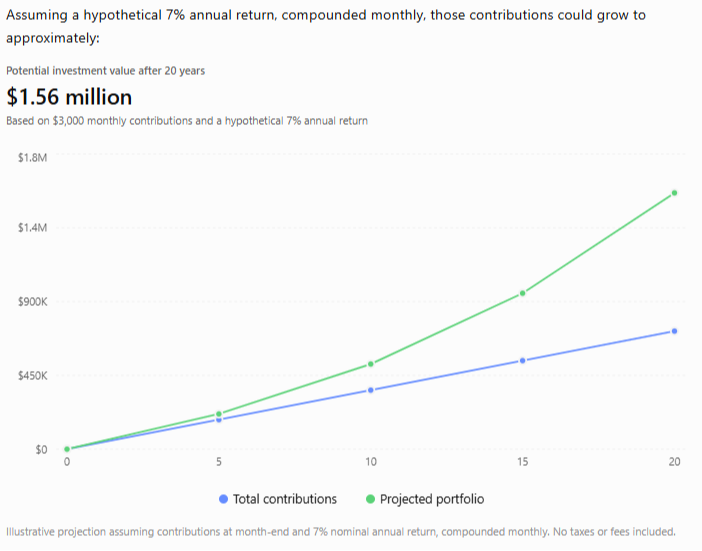
Over those 20 years, the owner would have contributed $720,000.
The remaining approximately $843,000 would represent hypothetical investment growth.
Of course, actual investment returns will vary, and markets don't provide consistent returns every year. This example doesn't account for taxes, investment expenses, or inflation, and the illustrated return isn't guaranteed.
But it demonstrates an important concept.
While you're focused on growing your company, a consistently funded investment portfolio has the potential to grow alongside it.
And unlike the value of your business, those investments don't necessarily depend on finding a buyer or successfully transitioning ownership when you're ready to retire.
Create a System, Not Just Good Intentions
The biggest challenge for many business owners isn't understanding that investing is important.
It's making investing a consistent priority.
A practical approach might involve establishing an annual personal savings goal, identifying appropriate retirement plan contributions, and scheduling regular transfers to investment accounts.
During especially profitable years, additional distributions might be directed toward personal investments after considering business reserves, taxes, debt obligations, and future capital needs.
During more challenging years, contributions may need to be adjusted.
The objective isn't to create an inflexible system that jeopardizes the business.
It's to establish a repeatable process that allows personal wealth to grow alongside business success.
After all, you probably wouldn't operate your company for 20 years without measuring its financial progress.
Your personal retirement plan deserves the same attention.
The most successful entrepreneurs don't necessarily wait until they sell their businesses to become financially independent—they build personal wealth throughout their careers by consistently turning business income into long-term investments.
Final Thoughts
Building a successful business is an incredible accomplishment.
It takes hard work, sacrifice, financial risk, and years of dedication.
But after spending decades building something valuable, business owners should be able to enjoy more than just the satisfaction of running a successful company.
They should also have the opportunity to enjoy the financial rewards of everything they've built.
And that requires looking beyond revenue, profitability, and business valuation.
Measure Your Personal Financial Progress
As your business grows, your personal financial position should ideally be improving alongside it.
That doesn't mean your personal net worth needs to increase every year. Investment markets fluctuate, businesses experience difficult periods, and financial priorities change.
But over time, you should be able to answer a few important questions:
Are my retirement accounts and personal investments growing?
Am I accumulating meaningful assets outside my business?
Could I maintain my lifestyle if I needed to reduce my involvement in the company?
How much of my family's financial future depends on the continued success of the business?
Am I getting closer to financial independence, or simply operating a larger company?
These questions can help shift your focus from measuring only business success to measuring what that success is actually accomplishing for you and your family.
Give Yourself More Choices
Financial independence doesn't necessarily mean retiring early or selling your company.
You may love what you do.
You may want to continue growing the business for another 20 years.
You may hope to transition ownership to your children, sell to employees, or eventually bring in a successor.
That's perfectly fine.
The goal isn't necessarily to stop working.
The goal is to reach a point where continuing to work becomes a choice rather than a financial necessity.
Imagine having enough personal investments and retirement savings that you no longer need every dollar your business generates.
You could reinvest more strategically.
Take additional time with your family.
Pursue charitable opportunities.
Transition into a different role.
Or simply enjoy operating the company without feeling that your entire financial future depends on its next profitable year.
That's the kind of flexibility that personal wealth can create.
Remember Why You Started
Most entrepreneurs don't start businesses because they want more paperwork, additional employees to manage, or endless financial responsibilities.
They start because they see an opportunity.
An opportunity to build something.
To provide for their families.
To serve their customers.
To create jobs.
To establish a legacy.
And hopefully, to gain greater control over their financial futures.
But somewhere along the way, it's easy for the business itself to become the destination rather than the vehicle helping you reach it.
A bigger business isn't always a better business.
More revenue doesn't automatically mean more wealth.
And a higher business valuation doesn't necessarily mean greater financial independence.
Sometimes the most important financial decision a business owner can make isn't where to invest the next dollar in the company.
It's deciding when to begin investing more intentionally in their own future.
The ultimate reward for building a successful business isn't simply owning something valuable—it's creating enough personal wealth and financial flexibility that your business can support the life you want, rather than your life always having to revolve around the business.
Continue Your Wealth Planning Journey
Building a successful business and building personal wealth should work together.
Whether you're just beginning to accumulate retirement savings or looking for ways to turn years of business success into greater financial independence, understanding your investment and retirement planning options is an important place to start.
If you'd like to continue learning, I encourage you to explore my Entrepreneur's Guide to Retirement Plans, Guide to ETF Investing, and Guide to Mutual Fund Investing.
These free educational resources explore retirement savings opportunities, investment strategies, diversification, and ways to build wealth beyond your business.
Simply click the Free Wealth Guides link at the top of the page to access these resources and continue building a financial future that reflects everything you've worked so hard to accomplish.