September gave investors plenty to worry about.
Oil prices remained elevated, inflation stayed above the Federal Reserve's target, long-term Treasury yields climbed to levels not seen in nearly two decades, and the Fed raised interest rates for the first time since 2023.
Yet underneath those headlines, the U.S. economy continued to demonstrate surprising resilience.
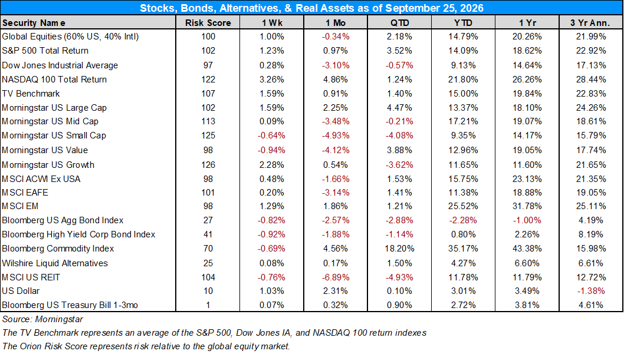
Corporate earnings remained strong. Consumer spending held up. Manufacturing and services continued expanding. Artificial intelligence investment continued pouring into the economy. And despite volatility during the month, the S&P 500 finished September nearly flat and remained solidly positive for the year.
Perhaps the most interesting development is that some of the same economic strength supporting corporate profits has also made the Federal Reserve's job more difficult.
A stronger economy is generally good news.
But when inflation remains elevated, good economic news can also mean interest rates stay higher for longer.
That tension may continue to shape markets as we enter the final quarter of 2026.
What Happened
· The Fed raised interest rates. The Federal Reserve increased its target rate by 0.25% in September, bringing the federal funds target range to 3.75%–4.00%. It was the first rate hike since 2023 as policymakers continued working to bring inflation back toward their 2% target.
· Inflation remained stubborn. August CPI increased 3.4% year over year, marking another month in which inflation remained above the Fed's target. Higher energy prices added another layer of uncertainty to the inflation outlook during September.
· The economy continued to surprise to the upside. Early-September data showed manufacturing and services expanding, while the Atlanta Fed's estimate at the time reached 4.7% for Q3. Later in the month, September flash PMIs remained firmly expansionary.
· Corporate earnings remained a major source of support. Q1 and Q2 S&P 500 earnings grew approximately 28% and 52%, respectively, while estimates entering Q3 continued to point toward another quarter of substantial earnings growth.
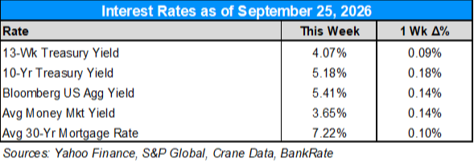
· Long-term interest rates moved sharply higher. The 10-year Treasury yield moved above 5.2% late in September, its highest level since 2007. That has pushed borrowing costs higher for consumers and businesses, including 30-year mortgage rates above 7%.
· September's employment report changed the conversation. The report showed payroll growth slowing to 29,000 and unemployment edging up to 4.2%. Markets responded by substantially reducing the probability of another rate hike at the Fed's October meeting.
What We’re Watching
· The Federal Reserve – September's rate hike confirmed that the Fed remains committed to bringing inflation back toward its 2% target. But the latest employment report complicates the picture. Inflation remains too high while employment growth appears to be slowing. That puts the Fed back in the familiar position of balancing its two mandates: stable prices and maximum employment.
· Long-Term Interest Rates – The 10-year Treasury moved above 5% during September, but why rates are rising may be almost as important as the fact that they are rising. Higher real rates can reflect stronger expectations for economic growth rather than simply higher inflation.
· The Consumer – Consumers have repeatedly been more resilient than sentiment surveys might suggest. August retail sales increased 1.2%, exceeding expectations and posting their strongest monthly gain in five months. We'll be watching whether higher borrowing costs, mortgage rates and inflation begin to change that picture.
· Corporate Earnings – Earnings have been one of the strongest arguments supporting stocks in 2026. Interestingly, the S&P 500 gained approximately 14% through September while its forward P/E fell from roughly 22x at the beginning of the year to around 19x. Stock prices increased, but earnings increased even faster.
· Artificial Intelligence Investment – AI is becoming more than a stock-market story. Spending on data centers, semiconductors, power generation and other infrastructure is increasingly becoming an economic-growth story. Recent economic research continues to identify AI infrastructure investment as an important contributor to U.S. growth. We'll continue watching whether the earnings ultimately generated by AI justify the extraordinary amount of capital being invested.
Investor Takeaway
Higher Interest Rates Aren't Bad for Everyone
For most of the past few years, we've discussed higher interest rates primarily as a challenge.
Higher rates increase mortgage payments. They make financing a business more expensive. They increase the government's cost of servicing its debt. And because bond prices generally fall when interest rates rise, existing bond investors have endured a difficult period.
But there is another side to the story.
Today's higher rates mean investors are finally being paid meaningful income to lend money again.
Consider the difference.
In July 2020, the 10-year Treasury yielded approximately 0.62%.
By September 2026, that yield had reached approximately 5%.
That's an enormous change in the starting point for a fixed-income investor.
There’s roughly a 90% correlation between a bond's starting yield and the return ultimately earned on that bond. While there are no guarantees, starting yield has historically been one of the better indicators of longer-term bond returns.
After one of the most difficult stretches for bonds in recent memory, the math is becoming considerably more attractive.
Why It Matters to Your Financial Plan
Bonds aren't designed to replace stocks.
They serve a different purpose.
For retirees and investors approaching retirement, higher yields can potentially provide more income without requiring the same level of equity-market risk. That can be particularly valuable when building an income strategy designed to fund near- and intermediate-term spending while allowing longer-term investments time to grow.
For accumulators, higher yields also mean the conservative portion of a diversified portfolio has the potential to contribute more meaningfully to total return.
And for investors holding significant amounts of cash, today's environment makes the decision more nuanced. Cash may offer attractive short-term yields, but it still needs to be considered alongside inflation, reinvestment risk, taxes and long-term growth needs.
The question shouldn't simply be, "Are interest rates high?"
The better question is:
"How can today's interest-rate environment help us accomplish the goals in your financial plan?"
A Datapoint Worth Discussing
Incomes Are Rising and Poverty Is Falling—So Why Do So Many Americans Still Feel Behind?
One of the more encouraging economic reports released in September received relatively little attention.
According to the U.S. Census Bureau, real median household income increased 2.6% in 2025 to $87,460—the highest level on record dating back to 1967. At the same time, the official poverty rate declined to 10.2%, its lowest level since the government began tracking the statistic in 1959.
Those are positive developments.
But they don't mean everyone is doing well.
Millions of Americans continue to struggle with the cost of housing, transportation, education, insurance and everyday expenses. Housing affordability in particular has become one of today's biggest financial concerns. Higher mortgage rates certainly haven't helped with 30-year mortgage rates reaching 7%.
But I think there is an important distinction worth making:
Housing affordability isn't simply an interest-rate problem.
Housing can be considered unaffordable for many Americans when mortgage rates are 7%. It was considered unaffordable when rates were 5%. And affordability was still a major concern during the extraordinarily low-rate environment of the 2010s and early 2020s.
Interest rates matter. Home prices matter. Housing supply matters.
But so do income, career progression, consumer debt, savings and financial preparation.
For many first-time buyers, purchasing a home has historically been a financial stretch. The first few years can be difficult because the mortgage payment represents a larger percentage of a younger household's income. With a traditional fixed-rate mortgage, however, the principal-and-interest payment stays the same while income has the potential to rise over a career. A payment that feels uncomfortable at 30 may look very different at 35 or 40.
That doesn't mean everyone should stretch to buy a house. Quite the opposite.
It means the financial decisions that come before buying the house matter.
Why It Matters to Your Financial Plan
There is a temptation to look at today's home prices and mortgage rates and conclude that the path to homeownership—or financial success more broadly—has disappeared.
I don't think that's the right lesson.
For many households, financial progress is less about finding the perfect economic environment and more about doing the right things in the right order.
- Develop a valuable skill. Education doesn't have to mean a four-year degree. College, trade school, certifications, apprenticeships and specialized training can all create skills the marketplace values.
- Build a career around that skill. Early-career income isn't necessarily permanent income. Developing expertise, gaining experience and increasing your value to an employer or customers can change your financial picture substantially over time.
- Pay down consumer debt. A large auto payment, credit-card balance or student loan doesn't just reduce monthly cash flow—it can reduce how much house you can responsibly afford.
- Build an emergency fund. Homeownership comes with expenses beyond the mortgage. Having cash reserves can keep a furnace, roof or unexpected repair from becoming new debt.
- Then build the down payment. A house should ideally be the next step in a sound financial foundation, not a substitute for one.
None of this suggests housing is inexpensive today. It isn't. Supply constraints, higher prices and elevated mortgage rates are real obstacles, particularly for younger buyers. Current estimates suggest the country also has a shortage of homes affordable to middle-income households.
But waiting for houses to suddenly become "affordable" may not be a financial plan either.
Twenty years from now, today's first-time buyers may look back at today's home prices the same way many homeowners today look back at what houses cost 20 years ago.
The better approach is to focus on the things we can control:
Build skills. Grow income. Avoid unnecessary debt. Save consistently. Buy what you can reasonably afford. Give your income—and time—the opportunity to do the rest.
That's financial planning.
And it matters regardless of where interest rates happen to be.
Long-Term Perspective
The Perfect Time Rarely Arrives
There is a common thread running through many of today's financial concerns.
Potential homebuyers are waiting for mortgage rates to fall.
Investors are waiting for stock valuations to become more attractive.
Savers are wondering whether today's higher yields mean they should remain in cash.
Others are waiting for inflation to fall, the Federal Reserve to finish changing rates, the election to pass, or economic uncertainty to disappear.
The problem is that the perfect financial environment rarely arrives.
Twenty years ago, the concerns were different. Twenty years from now, they will be different again.
There will always be a reason to wait.
Long-term financial success usually comes from making reasonable decisions with the information available today and then allowing income growth, saving, investing, compounding and time to work in your favor.
Consider homeownership. A mortgage payment that feels significant early in a career can become more manageable as income rises, particularly with a fixed-rate mortgage where principal and interest don't increase simply because your income does.
Investing works similarly.
The market may look expensive when you begin. A recession may eventually occur. Interest rates will change. There will be elections, wars, bear markets and periods of uncertainty.
Yet an investor who continually waits for a better entry point can lose something that is impossible to recover:
Time.
That's why we continue emphasizing the importance of staying invested. The goal isn't to identify the perfect moment to invest. It's to give your money as much time as reasonably possible to participate in the long-term growth of businesses and the economy.
Why It Matters to Your Financial Plan
A good financial plan isn't built around everything going right.
It's built around making progress even when conditions aren't perfect.
Build your career and increase your earning potential.
Control debt and maintain adequate reserves.
Save consistently.
Buy a home when it fits your finances—not simply because rates are low or because everyone else is buying.
Invest according to your goals and time horizon rather than waiting for the headlines to become comfortable.
And once you've invested, give the plan time to work.
Markets will change. Interest rates will change. Home prices will change. Your income will change.
The things you can control are your decisions, your discipline and the amount of time you give those decisions to compound.
The perfect time may never arrive.
Start with what you can control. Stay disciplined. Stay invested. Give it time.