


As we move through the second half of 2026, markets continue to demonstrate remarkable resilience despite a growing list of challenges. Investors are navigating higher interest rates, evolving Federal Reserve policy, geopolitical uncertainty, and one of the largest waves of artificial intelligence investment in history. Yet beneath the headlines, corporate earnings remain strong, economic growth has exceeded many expectations, and market leadership is beginning to broaden beyond a handful of large technology companies.
Perhaps the biggest story isn't what has changed—but what hasn't. Throughout every market cycle, successful investing has continued to reward patience, discipline, diversification, and a focus on long-term fundamentals. While today's environment may look different from the last decade, the principles that have helped investors build wealth remain remarkably consistent.
Our goal each month is to help separate the daily headlines from the long-term trends that matter most to your financial future.
What Happened
- Corporate America continues to deliver. Second-quarter earnings are on pace for their strongest year-over-year growth since 2021, providing fundamental support for equity markets despite higher interest rates and geopolitical uncertainty.
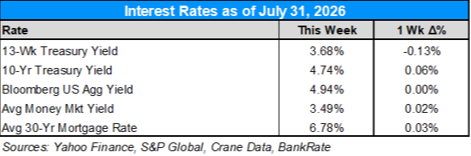
- The Federal Reserve remains cautious. Inflation has moderated from its peak but remains above the Fed's long-term objective, leading policymakers to maintain a more restrictive stance than many investors expected at the beginning of the year.
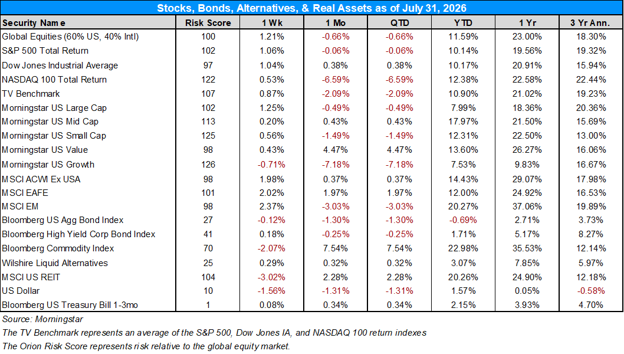
- Market leadership continues to broaden. While artificial intelligence remains an important investment theme, strength has expanded into sectors including energy, industrials, capital goods, and portions of the international markets. Beneath relatively calm index performance, there has been significant variation among sectors and individual companies.
- Geopolitical tensions remain a factor. Continued uncertainty surrounding the Middle East has supported higher oil prices and reminded investors that geopolitical events can create short-term volatility, even as long-term market trends remain driven by economic fundamentals.
What We’re Watching
- FederalReserve Policy – The Federal Reserve remains focused on bringing inflation back toward its long-term target while balancing the risk of slowing economic growth. Investors will be watching inflation data, employment reports, and comments from Fed officials for clues about the direction of future interest rates. While markets often react to each Fed meeting, long-term investment success has historically depended more on staying invested than trying to predict the Fed's next move
- Corporate Earnings – Second-quarter earnings have been exceptionally strong, providing the fundamental support behind this year's market gains. As earnings season continues, we'll be watching whether companies can maintain profit growth despite higher borrowing costs, persistent inflation, and evolving global trade dynamics.
- Artificial Intelligence & Market Leadership – Artificial intelligence remains one of the market's biggest investment themes, but leadership has broadened into sectors such as energy, industrials, financials, and international equities. We'll be watching whether this trend continues as investors look beyond a handful of large technology companies.
- Inflation & Consumer Spending – Inflation has moderated from its peak but remains above the Federal Reserve's long-term objective. Consumer spending, wage growth, and employment continue to be key indicators of economic health and will likely influence both Federal Reserve policy and market sentiment in the months ahead.
- Washington & Retirement Policy – Congress is beginning to focus more seriously on Social Security's long-term financial outlook. A recently introduced bipartisan proposal, known as the PROMISE Act (Protecting Retirement Opportunities and Maintaining Income Security for Everyone), would establish an independent bipartisan advisory committee tasked with developing recommendations to restore Social Security's long-term solvency. Rather than prescribing specific benefit cuts or tax increases, the legislation is designed to require Congress to vote on a comprehensive plan intended to keep the program financially sound for at least the next 50 years. The proposal comes as the Social Security Trustees project the retirement trust fund could face a funding shortfall beginning in 2032 if no action is taken.
Investor Takeaway
For much of the past decade, investors benefited from historically low interest rates, abundant liquidity, and strong returns from a relatively small group of large technology companies. Simply owning broad market indexes often proved to be an effective strategy.
Today's environment appears different.
Interest rates are higher. Inflation remains a consideration. Valuations matter more. The difference between the strongest- and weakest-performing investments has widened considerably, creating an environment where company fundamentals, earnings growth, balance sheet strength, and thoughtful portfolio construction are becoming increasingly important.
Institutional investment firms have described this environment in different ways—"the return of the stock picker," "active judgment," and "greater market dispersion." While the terminology differs, the underlying message is remarkably consistent: successful investing may increasingly depend on careful analysis rather than simply following market momentum.
Why It Matters to Your Financial Plan
Market environments change, but successful investing has never depended on predicting every headline or economic report. Instead, long-term investors benefit from maintaining diversified portfolios, focusing on quality investments, and remaining disciplined through changing market cycles.
This does not necessarily mean abandoning passive investing or dramatically changing your strategy. Rather, it reinforces the importance of thoughtful portfolio construction—using the right investments for the right objectives while avoiding unnecessary concentration in any single company, sector, or investment theme.
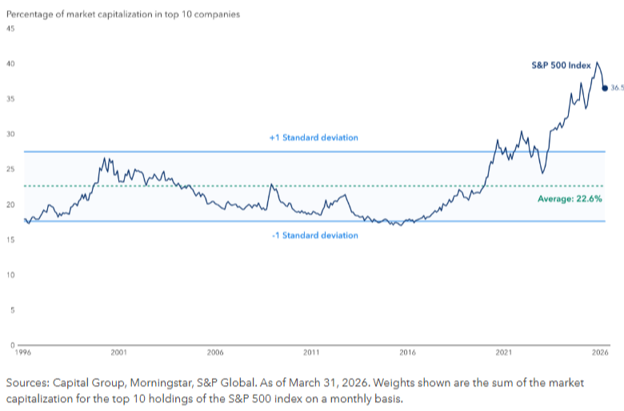
Index fund investors may hold high concentration risk
Long-Term Perspective
Diversification Isn't Designed to Win Every Year
One of the healthiest developments we've seen in 2026 is the broadening of market leadership. While artificial intelligence has captured much of the attention, investors have also benefited from strength in energy, industrials, international equities, and other areas of the market that received far less publicity.
This serves as an important reminder of why diversification remains one of the most valuable principles in investing.
Diversification rarely produces the single best-performing portfolio in any given year. Instead, it is designed to reduce dependence on one investment, one sector, or one economic outcome. As market leadership inevitably changes over time, diversified investors are often better positioned to participate in new opportunities without needing to predict where they will emerge.
Why It Matters to Your Financial Plan
Successful investing isn't about owning whichever investment performed best last year. It's about building a portfolio that can adapt as markets evolve while remaining aligned with your long-term goals.
By maintaining diversification, staying invested, and focusing on fundamentals rather than short-term headlines, investors place themselves in a stronger position to pursue long-term financial success regardless of the next market cycle.
If you have any questions about your portfolio or how current market conditions may impact your plan, please don’t hesitate to reach out. We’re here to help.